Claude in 2026 - Powering the Future of Human-AI Collaboration

Anthropic has quickly positioned itself as one of the most thoughtful & safety-focused players in the AI ecosystem. Founded with a mission to build reliable, interpretable & steerable AI systems, the company has emphasized responsible scaling of intelligence from day one.
Backed by leading technology partners & enterprise interest, Anthropic is not just building models - it is shaping how AI should be developed, governed & deployed in real-world environments.
At the center of this vision is Claude - a next-generation AI system designed to go beyond simple task execution. Claude is built for reasoning, contextual understanding & meaningful collaboration with humans. It supports complex workflows, enterprise use cases & decision-making processes, all while maintaining a strong focus on safety, alignment & transparency. As we move into 2026, Claude represents a shift from AI as a tool to AI as a true partner in how we think, build & innovate.
2026 grounding - Anthropic’s current public product stack now includes Claude Opus 4.6 & Claude Sonnet 4.6. Sonnet 4.6 is positioned for coding, computer use, long-context reasoning, agent planning, knowledge work & design & includes a 1M-token context window in beta. Claude is also available through the Claude Platform, Amazon Bedrock, Google Cloud Vertex AI & Microsoft Foundry.
The Evolution of Claude into a Strategic AI Platform
Claude’s journey in 2026 reflects a fundamental shift - from being a conversational assistant to becoming a strategic AI platform embedded within enterprise ecosystems. Organizations are no longer experimenting with AI at the edges; they are integrating it into the core of their operations. Claude is now positioned not just as a tool, but as a capability layer that augments decision-making, accelerates execution & enables intelligent orchestration across systems.
What differentiates Claude in this evolution is its ability to operate with context, continuity & domain awareness. It is no longer about responding to prompts - it is about understanding intent over time, connecting data across silos & delivering outcomes that are aligned with business objectives. This transformation moves AI from reactive assistance to proactive participation.
From a technology leadership perspective, this shift requires a rethinking of architecture. Claude becomes a central intelligence layer, sitting across applications, data platforms & workflows. It demands tighter integration with APIs, data pipelines & enterprise systems - enabling real-time insights & actions. The focus is no longer on isolated use cases, but on building a cohesive AI-enabled enterprise fabric.
Equally important is the shift in how organizations measure value. The conversation is moving from productivity gains to strategic advantage - speed of innovation, quality of decisions & ability to scale intelligence across the enterprise. Claude is enabling leaders to think beyond automation & toward transformation.
Ultimately, the evolution of Claude signals a broader trend - AI becoming a foundational layer of business. The organizations that recognize this early & architect for it intentionally, will be the ones that lead in the next decade.
Claude’s Expanding Role in Workflows
The transition from assistance to autonomy marks one of the most defining phases in Claude’s evolution. In 2026, Claude is not just supporting workflows - it is participating in them, taking on tasks that require reasoning, sequencing & decision-making. This changes the very nature of how work gets done.
Autonomy does not mean replacing humans; it means redefining roles. Claude operates as a collaborative agent, handling repetitive, data-intensive & multi-step processes, while humans focus on judgment, creativity & strategy. This creates a new model of work - one where humans & AI operate in tandem, each amplifying the other’s strengths.
From a technical standpoint, enabling autonomy requires advancements in orchestration, memory & guardrails. Claude must maintain context across interactions, execute tasks across systems & operate within defined boundaries. This introduces new challenges in reliability, monitoring & governance - areas where technology leaders must invest deeply.
There is also a cultural shift that accompanies this transition. Organizations must build trust in autonomous systems, define clear accountability models & ensure that AI decisions are transparent & explainable. Leadership plays a critical role in driving this change - not just in technological adoption, but in mindset transformation.
This shift from assistant to agent is already visible in market-facing capabilities. In early 2026, Anthropic introduced scheduled tasks in Cowork, persistent agent threads, plugin administration & computer use in research preview, signaling a move from conversational support toward bounded, multi-step execution.
As Claude continues to expand its role in workflows, the
focus will shift from
“what can AI do?”
to
“what should AI do?”
The answer to that question will define the future of human-AI collaboration & the organizations that navigate this thoughtfully will unlock unprecedented levels of efficiency, innovation & impact.
Human-AI Collaboration Redefined Through Context, Memory & Intelligence
Human-AI collaboration is moving beyond transactional interactions into deeply contextual partnerships. Systems like Claude are no longer just responding to prompts - they are beginning to understand intent, continuity & nuance. This shift enables AI to participate in workflows as a thinking partner rather than a reactive tool.
Context is becoming the new currency of intelligence. With the ability to retain & process relevant information across interactions, AI can now provide more meaningful, consistent & personalized outputs. This reduces friction, improves decision quality & allows humans to focus on higher-value thinking instead of repetitive orchestration.
Memory, when used responsibly, transforms AI from a session-based assistant into a long-term collaborator. It enables continuity across projects, teams & decisions. However, this also introduces the need for strong governance, transparency & user control, ensuring that memory enhances trust rather than erodes it.
Memory has also become a real product capability rather than a conceptual aspiration. By March 2026, memory from chat history was available to all Claude users, including free users & Anthropic added import & export support so users can carry persistent context across tools & workflows with greater control.
Intelligence in this new paradigm is not just about accuracy, but about alignment. The most valuable AI systems are those that understand business context, adapt to evolving needs & provide recommendations that are both technically sound & practically relevant. This is where AI begins to augment human judgment rather than replace it.
The future of collaboration lies in this balance where humans bring creativity, empathy & strategic thinking & AI brings scale, speed & contextual intelligence. Organizations that master this synergy will redefine productivity & innovation in the years ahead.
Enterprise Adoption of Claude Across Industries & Complex Use Cases
Enterprise adoption of AI like Claude is accelerating, driven by the need for efficiency, intelligence & competitive differentiation. Organizations are moving beyond experimentation into structured, production-grade deployments that integrate deeply with business processes.
Across industries, use cases are becoming more sophisticated. From customer experience & knowledge management to software development & operations, AI is being embedded into core workflows. The focus is no longer on isolated use cases, but on creating interconnected ecosystems where AI enhances every layer of the organization.
A key trend is the shift toward platform thinking. Enterprises are not just adopting AI tools; they are building AI-enabled platforms that can scale across functions. Claude’s ability to integrate, reason & adapt makes it a strong candidate for such foundational roles within enterprise architecture.
However, adoption at scale requires more than technology. It demands change management, skill transformation & alignment across business & IT teams. Organizations must invest in training, governance & clear value frameworks to ensure that AI delivers measurable outcomes.
Enterprise readiness is broadening at the workflow layer as well. Claude can now coordinate across Excel, PowerPoint & Word, while its Microsoft 365 connector enables access across SharePoint, OneDrive, Outlook & Teams. Anthropic has also introduced self-serve Enterprise plans & an Enterprise Analytics API for organizational usage visibility.
Looking ahead, the enterprises that succeed will be those that treat AI not as a feature, but as a capability. By embedding intelligence into decision-making, operations & customer interactions, they will unlock new levels of agility, innovation & long-term value.
Balancing Power with Responsibility in Advanced AI Systems Deployment
As AI systems like Claude grow in capability, the conversation is no longer just about what AI can do, but what it should do. Enterprises are moving from experimentation to scaled deployment & with that comes a fundamental shift - responsibility is now as critical as performance. Leaders must ensure that AI is not only powerful, but predictable, auditable & aligned with organizational values.
Responsible deployment begins with governance by design. This means embedding guardrails into the architecture itself - access controls, usage boundaries, monitoring frameworks & explainability layers. AI systems must be observable, with clear visibility into decisions, actions & outcomes. Without this, scale introduces risk faster than it delivers value.
Equally important is the concept of human-in-the-loop intelligence. While automation drives efficiency, unchecked autonomy can lead to unintended consequences. The most effective organizations are designing hybrid models where AI augments human judgment rather than replacing it, ensuring accountability remains intact.
Another emerging priority is data integrity & lineage. As Claude interacts with multiple systems, the quality, origin & transformation of data become critical. Trust in AI outputs is directly proportional to trust in the data ecosystem that feeds it. This requires strong data governance, cross-system validation & continuous monitoring.
Ultimately, responsible AI is not a compliance checkbox - it is a leadership mindset. Organizations that proactively invest in ethical frameworks, transparency & accountability will not only mitigate risks but also build long-term trust with customers, employees & stakeholders.
This governance posture is increasingly formalized. Anthropic updated its Responsible Scaling Policy to version 3.0 in February 2026 & continues to publish model system cards that document capabilities, safety evaluations & deployment decisions for models such as Sonnet 4.6, Opus 4.6 & Mythos Preview.
The Rise of AI-Augmented Decision Making in Business Environments
We are entering an era where decisions are no longer made with data, but alongside intelligent systems. Claude is enabling a new paradigm, AI-augmented decision making, where insights are generated in real time, patterns are surfaced proactively & recommendations are contextualized for immediate action.
This shift is redefining how leaders operate. Decision cycles are shrinking & the expectation is moving from reactive analysis to predictive foresight. Claude’s ability to synthesize large volumes of structured & unstructured data allows organizations to move from intuition-driven decisions to intelligence-assisted outcomes.
However, the real value lies not just in speed, but in decision quality. AI can surface options, simulate scenarios & highlight risks - but the final judgment still requires human context, experience & accountability. The balance between AI recommendations & human intuition becomes a critical differentiator.
Organizations are also beginning to leverage Claude for decision democratization. Insights are no longer confined to leadership layers; they are accessible across teams, enabling faster & more informed actions at every level. This flattens decision hierarchies & empowers individuals to act with confidence.
Looking ahead, the winners will be those who integrate AI deeply into their decision fabric - not as a tool, but as a strategic partner. The future is not about replacing decision-makers, but about elevating them to operate at a higher level of clarity, speed & impact.
Claude vs Competitors - The 2026 AI Landscape
As AI platforms rapidly evolve, comparing them is no longer about “which is better” - it is about which is better for what purpose. Each model brings a unique strength depending on the use case - whether it is deep reasoning, creative generation, multimodal interaction, or enterprise scalability. For leaders & architects, the real value lies in understanding these nuances & aligning the right AI capability with the right business problem.
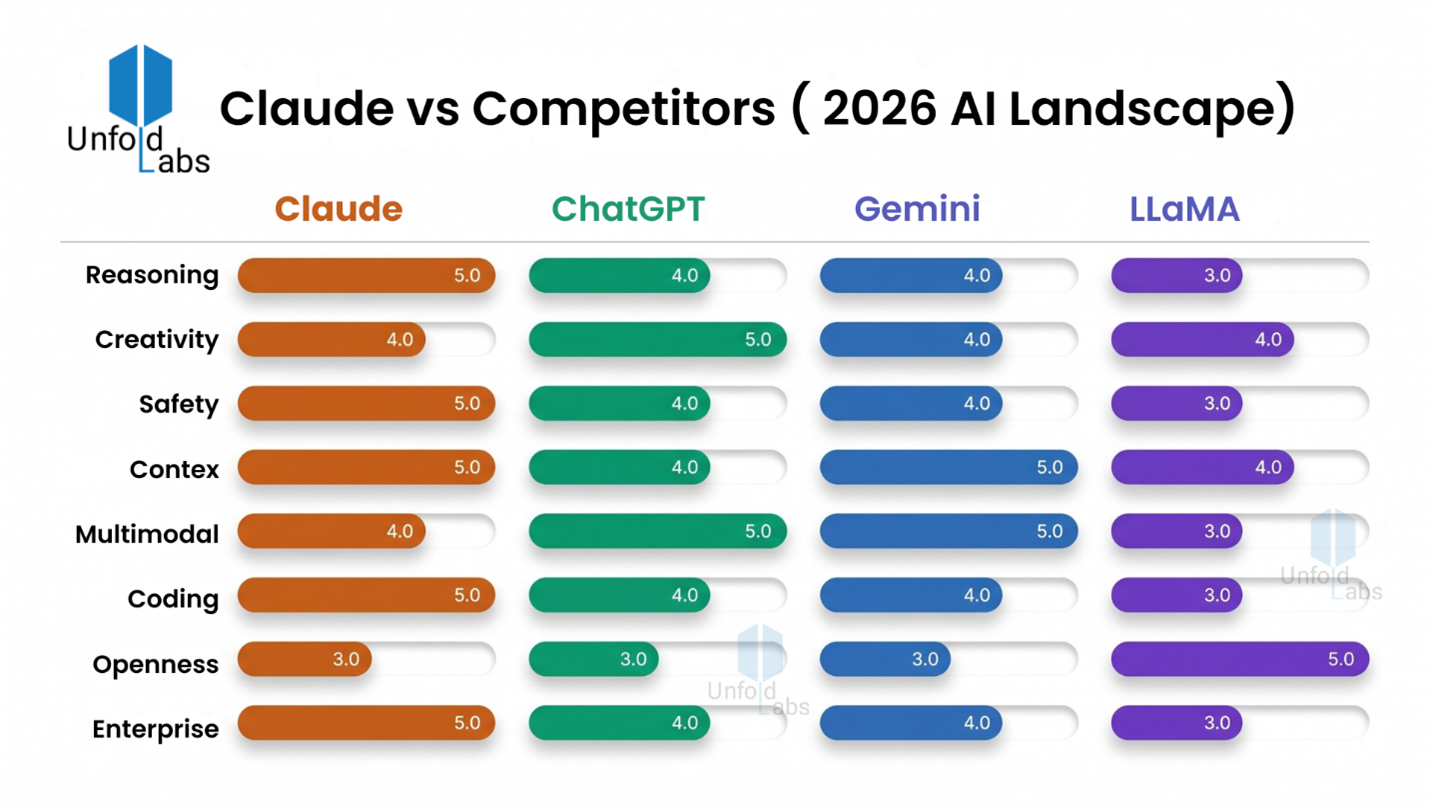
The above comparison highlights a broader shift in the AI landscape - specialization over generalization. While some platforms focus on creativity & ecosystem integration, others like Claude are doubling down on reasoning depth, safety & enterprise readiness. The future will not be dominated by a single model, but by an ecosystem of AI capabilities, where organizations thoughtfully combine strengths to build resilient, scalable & intelligent solutions.
Claude & the Ecosystem Play - Building Beyond the Model
As AI matures, the real differentiator is no longer just the model, it is the ecosystem around it. Claude is not positioned as a standalone capability, but as a platform that enables partners, developers, enterprises & innovators to build, extend & scale intelligence across industries. This ecosystem-first approach is what will define long-term success in the AI space.
Anthropic also gave this ecosystem strategy a clearer structure in March 2026 by launching the Claude Partner Network, committing an initial $100 million for 2026 & introducing Claude Certified Architect, Foundations as its first technical certification for partners.
Claude & the Ecosystem Play - Building Beyond the Model
As AI matures, the real differentiator is no longer just the model, it is the ecosystem around it. Claude is not positioned as a standalone capability, but as a platform that enables partners, developers, enterprises & innovators to build, extend & scale intelligence across industries. This ecosystem-first approach is what will define long-term success in the AI space.
Anthropic also gave this ecosystem strategy a clearer structure in March 2026 by launching the Claude Partner Network, committing an initial $100 million for 2026 & introducing Claude Certified Architect, Foundations as its first technical certification for partners.
-
Partner Types: Expanding Reach Through Strategic
Collaboration
The Claude ecosystem brings together a diverse set of partners - from hyperscalers & cloud providers to system integrators, startups & enterprise technology platforms. Each partner type plays a distinct role in extending Claude’s capabilities into real-world applications.
- Cloud partners enable scalability & infrastructure, ensuring Claude can operate efficiently across geographies & workloads.
- System integrators & consulting firms bring domain expertise, helping translate AI capabilities into industry-specific solutions that deliver measurable business value.
- Startups & ISVs add innovation at the edge, building niche applications & experimenting with new use cases.
This layered partner strategy ensures that Claude is not just adopted - but embedded deeply into enterprise & innovation ecosystems.
-
Certifications: Building Trust Through Structured
Enablement
As enterprises adopt AI on a scale, certifications become critical in ensuring consistency, quality & trust. Claude’s ecosystem emphasizes structured learning paths that enable developers, architects & business leaders to effectively understand & implement its capabilities.
Certification programs help standardize best practices - from prompt engineering & system design to governance & ethical AI usage. This ensures that implementations are not only technically sound but also aligned with enterprise standards & compliance requirements.
More importantly, certifications create a community of skilled professionals who can confidently deploy Claude solutions. This builds a strong talent pipeline & accelerates adoption across organizations globally.
-
The $100M Fund: Accelerating Innovation at
Scale
A key pillar of the ecosystem strategy is investment in innovation. The $100M fund signals a commitment to supporting startups, developers & organizations that are building on top of Claude’s capabilities.
This fund is designed to accelerate experimentation - enabling teams to take risks, explore new ideas & build next-generation applications powered by AI. It lowers the barrier to entry for innovation while encouraging bold, forward-thinking solutions.
Beyond funding, it creates a feedback loop between builders & the platform. As new use cases emerge, they inform the evolution of Claude itself - ensuring the platform continues to grow in alignment with real-world needs & opportunities.
Challenges in Governance, Trust & Ethical AI Implementation Globally
As AI systems like Claude evolve in capability, governance is no longer optional - it is foundational. Organizations must move beyond compliance checklists & begin designing governance as part of their architecture. This means embedding transparency, traceability & accountability into every AI-driven workflow.
Trust, however, is harder to engineer than technology. It is built through consistent outcomes, explainability & clear boundaries of what AI can & cannot do. Enterprises must invest in systems that not only deliver results but also provide confidence in how those results are generated.
A key challenge lies in global inconsistency. Regulatory frameworks differ across regions & AI systems operate across borders. Leaders must navigate this complexity by building adaptable governance models that can align with evolving global standards while maintaining operational efficiency.
Ethical implementation also requires intentional design choices. Bias mitigation, data privacy & responsible usage cannot be afterthoughts. They must be continuously monitored, measured & improved through feedback loops & human oversight.
Ultimately, governance is not about restricting innovation, it is about enabling sustainable scale. The organizations that succeed will be those that treat trust as a product, not a byproduct.
Coming Soon in Claude - The Next Wave of Intelligence
As Claude continues to evolve, the focus is shifting from capability to capability at scale, deeper intelligence, broader integration & more seamless human-AI collaboration. The next phase is not just about doing more, but doing it faster, safer & more contextually aware. What’s coming next signals a move toward AI systems that are more autonomous, more adaptive & deeply embedded into everyday workflows.
Several items in this section are now partially confirmed rather than purely future facing. As of April 2026, Mythos Preview exists as a gated research preview tied to Project Glasswing; memory, Office workflows, plugins & computer-use previews are already live, while broader video-native multimodality & fully general autonomous execution should still be framed as directional rather than universally released capabilities.
-
Mythos: Advanced AI for Cybersecurity & System
Intelligence
Mythos represents a significant leap - enabling AI to detect, simulate & potentially prevent complex vulnerabilities across systems. While powerful, it is being rolled out in controlled environments, signaling a strong emphasis on responsible innovation & secure deployment.
Mythos Preview is being used in the defensive-security initiative Project Glasswing, which includes launch partners such as AWS, Apple, Cisco, CrowdStrike, Google, JPMorganChase, Microsoft, NVIDIA & Palo Alto Networks. Anthropic says it is committing up to $100M in usage credits & $4M in donations to open-source security organizations for this effort.
-
Persistent Memory & Context Awareness Across
Interactions
Claude will move toward retaining context across sessions, enabling more meaningful & continuous interactions. This allows users & enterprises to build long-term workflows without repeatedly providing background, significantly improving efficiency & personalization.
-
Advanced Multimodal Capabilities Across Text, Image &
Video
Beyond text, Claude is expected to expand into richer multimodal interactions. This includes interpreting images, generating visual outputs & eventually working with video - opening up new use cases in design, diagnostics & content creation.
-
Deeper Enterprise Integrations with Core Business
Systems
Claude will integrate more seamlessly with enterprise systems like CRM, ERP & data platforms. This will enable real-time decision-making & automation directly within existing business workflows, reducing friction & increasing adoption.
-
Autonomous Agent Capabilities for Complex Task
Execution
The future will see Claude acting as an intelligent agent - capable of planning, executing & iterating on multi-step tasks. This moves AI from a reactive assistant to a proactive system that can manage end-to-end processes.
-
Enhanced Governance, Explainability & Compliance
Frameworks
With growing enterprise adoption, Claude will continue to strengthen its governance capabilities. This includes better explainability of outputs, stronger audit trails & built-in compliance mechanisms to meet global regulatory expectations.
-
Developer Ecosystem Expansion with Tools & SDKs
To accelerate innovation, Claude will offer richer developer tools, APIs & SDKs. This will empower teams to build customized applications faster, experiment with new ideas & extend Claude into unique & domain-specific solutions.
Looking ahead, these advancements are not isolated features, they represent a cohesive evolution toward a more intelligent, integrated & responsible AI platform. Claude is steadily moving from being a powerful model to becoming a foundational layer for how organizations think, build & operate in the AI-driven future.
The Road Ahead - Claude Shaping the Future of Work
The future of work will not be defined by AI replacing humans, but by how effectively humans collaborate with AI. Claude represents a shift toward systems that augment thinking, accelerate decision-making & enable new forms of productivity.
Work itself will become more fluid. Roles will evolve from execution-focused tasks to orchestration, judgment & creativity. Professionals will increasingly rely on AI as a co-pilot, one that enhances their capabilities rather than competes with them.
Organizations will need to rethink how they design teams. The integration of AI into workflows will require new skill sets, combining technical understanding with strategic thinking & human-centric design. Learning will become continuous, not episodic.
From a leadership perspective, the focus will shift toward enabling environments where humans & AI can thrive together. This includes investing in tools, training & cultural shifts that embrace experimentation & adaptability.
Looking ahead, Claude is not just a tool, it is a signal. A signal that the future belongs to those who can blend intelligence with empathy, automation with accountability & innovation with purpose.
AI is steadily moving beyond discrete interactions and into a more integrated role, where it supports workflows, informs decisions & operates with increasing context and continuity
Asokan Ashok
CEO, UnfoldLabs Inc.