2026 - AI Watermarking & the Future of Digital Trust

The chief financial officer was on the video call. So were familiar colleagues. Every face looked right & every voice sounded right. By the end of it, a finance employee had made 15 transfers worth about US$25.6 million. None of the other people on that call were real.
That happened in early 2024, & the tools have only improved since. The question is no longer whether content looks real. It is whether anyone can prove where it came from.
AI is no longer a technology that organisations are evaluating. It is one they are budgeting for. Gartner's September 2026 forecast puts worldwide AI spending at $2.67 trillion this year, up 49.5% from 2025, & projects $3.64 trillion in 2027. McKinsey's State of AI survey found that 88% of organisations now use AI in at least one business function. A spending forecast is not an outcome, & adoption is not the same as maturity.
But the direction is clear, & one consequence is already visible: text, images, audio & video are now produced by AI machines at a volume & quality that has changed what an ordinary person encounters in an inbox, on a feed or on a video call.
That growth has opened a quieter problem. When a machine can write a paragraph that reads as though a person wrote it, the reader has no reliable way to tell the difference. The International AI Safety Report 2026 cites studies in which participants judged AI-generated text to be human-written 77% of the time, & listeners mistook AI-generated voices for real speakers 80% of the time. The question that matters is shifting from whether content is good to where it came from.
In August 2026, Anthropic began embedding an invisible watermark in text generated by its Claude models, & other providers are moving in the same direction. This blog covers what Claude is doing & why, how text watermarking works, what other approaches exist & why this one has a fair chance of succeeding, how images & video are marked, where marking matters in practice & what it cannot do. The aim is a clear view of technology that will shape how organisations decide what to trust.
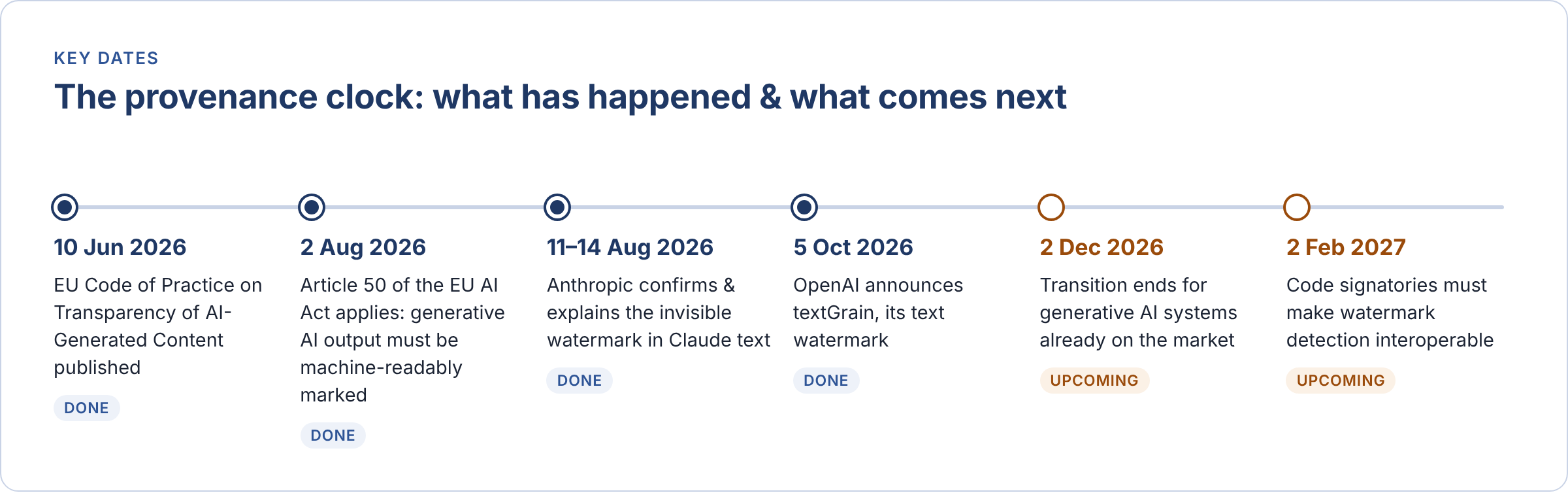
Regulatory deadlines under Article 50 of the EU AI Act (applicable from 2 August 2026) are accelerating provider adoption. Generative AI systems already on the market before that date must meet the marking requirement by 2 December 2026, and providers that signed the EU Code of Practice must make their watermark detection interoperable by 2 February 2027.
Why AI-Generated Content Is Becoming a Trust Problem
For most of the history of digital content, authorship was something a reader could usually infer. Style, patterns of error & context gave away a great deal. Those signals have weakened as models have improved. A fluent paragraph, a convincing photograph or a familiar voice no longer carries reliable information about who or what produced it. The International AI Safety Report 2026 names detection tools that cannot keep pace with generation quality as one of the central challenges for policymakers, alongside underreporting & the difficulty of tracing content back to its creators.
The business consequences are measurable. The FBI’s Internet Crime Complaint Center recorded more than $893 million in adjusted losses from 22,364 AI-related fraud complaints in 2025, in a report published in April 2026, a figure that is likely an undercount because many fraud reports do not yet record whether AI was involved. It was the first time the FBI had tracked AI as a separate category.. Deloitte's Center for Financial Services projects that generative-AI-enabled fraud losses in the United States will grow from $12.3 billion in 2023 to $40 billion by 2027. That is a projection, not a measurement, but the direction of travel is not in dispute.
These numbers describe a trust problem as much as a security problem. A reader, a customer, a regulator or a claims handler needs a way to ask where a piece of content came from, & guessing from appearance is a losing strategy when appearance can be manufactured. The more dependable approach is to mark content now it is created, by the system that creates it. That is the idea behind watermarking, & it explains why the model provider is best placed to do it: the system that makes the content can mark it from the inside.
Empirical study on 'Watermark Laundering' (Yang et al., 2026, arXiv:2602.04112) prove that public foundation image editors (e.g., GPT Image 2, Nano Banana 2) can decouple visual scene preservation (PSNR 30.27 dB, SSIM 0.879) from victim payload decoding (BER ~ 0.5) using a single natural-language reconstruction prompt, demonstrating that simple visual inspection is completely incapable of detecting payload disruption. Furthermore, open-source file-hygiene tools (e.g., Julie Meyers, 14,000 GitHub stars) now allow users to strip invisible Unicode tags, EXIF/C2PA metadata drawers, and execute lexical rephrasing across document formats.
Claude AI Watermarking: How Anthropic Is Marking AI-Generated Text
In August 2026, Anthropic confirmed that text generated by new Claude models carries an invisible watermark. The company updated the support page on 11 August & published a detailed explanation on 14 August. The driver is regulatory. Article 50 of the EU AI Act, which applies from 2 August 2026, requires providers of generative AI systems to mark their output in a machine-readable way. The European Commission published a Code of Practice on Transparency of AI-Generated Content on 10 June 2026, & Anthropic signed it in July, among about 190 signatories.
Anthropic is NOT alone.
The Commission's list of provider signatories includes Google, Meta, Microsoft, Mistral & OpenAI, & Article 50 applies to any provider serving the European market.
- Google has offered its SynthID technology for text in Gemini since 2024 & applies it to images, audio & video.
- OpenAI attaches Content Credentials to generated images & added SynthID watermarks to them in May 2026, & reports in October described an optional text-watermark feature for its API.
Systems that were already on the market before 2 August have a transition period, which several sources put at 2 December 2026. We should expect more text watermarks from other providers in the coming weeks, & the reason is not competition. It is a compliance requirement that every provider serving Europe must meet.
On 5 October 2026, OpenAI officially announced textGrain (entropy-calibrated text watermarking) for ChatGPT and model outputs across the EU, alongside a restricted detection API for regulators and researchers. Official EU Commission Guidelines published on 20 July 2026 confirm that signatories must deploy at least two machine-readable techniques (e.g., C2PA metadata + imperceptible watermarking). Exemptions apply to free-form text, closed hardware products and text under 200 tokens (~150 words). Non-compliance carries severe fines up to €7.5M / 1.5% for transparency rules, €15M / 3% for GPAI models, and €35M / 7% for prohibited practices.
How Claude AI Watermarking Works at the Model Level?
The watermark is applied at the model level, so it is present whichever Claude product produced the text: the API, Claude, Claude Code, Claude Cowork or Claude Tag. Anthropic applies to it worldwide rather than only in Europe, because it does not yet have a durable way to scope the mark by region. It covers models launched on or after 2 August. Anthropic has said it is working to extend watermarking to earlier models, & reports in early November indicate that the expansion is under way. Image & other files are handled differently. A file such as a PNG, JPG or SVG receives a signed content credential in its metadata under the open Coalition for Content Provenance and Authenticity (C2PA) standard, rather than a watermark in the content itself.
Anthropic is also explicit about what the watermark does not do. Nothing is added to the text, there are no hidden characters, no extra tokens & no added cost, & the mark carries no information that could identify a user, an organisation or a conversation. Anthropic reports have no practical effect on the quality of the output. What a detector can report is a probability that Claude was involved in producing the text. It cannot confirm that a person wrote something, it cannot identify text written by a different AI, & it cannot separate text Claude wrote from text Claude heavily edited.
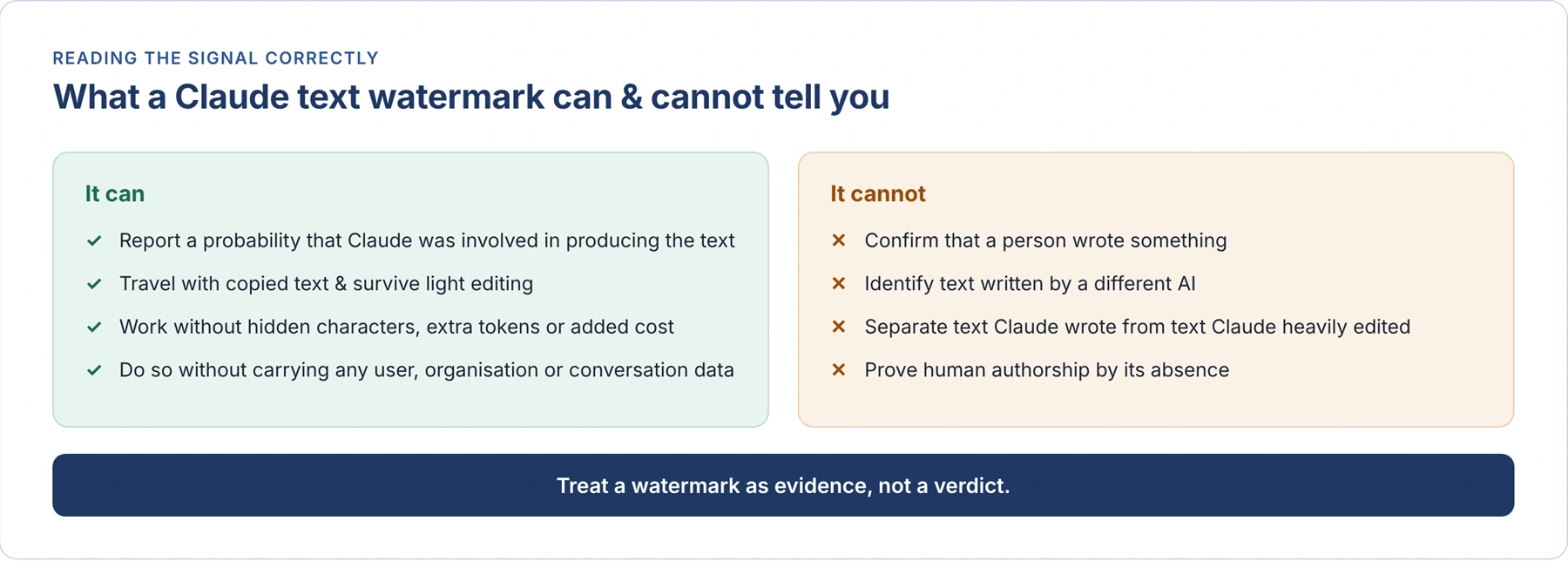
Detection is available through an API in private preview for eligible organisations, such as regulators, media, factcheckers, researchers & educational organisations, & for enterprises with their own verification duties under the Act. Anthropic plans to widen access over time.
Recent empirical studies (Ars Technica & The Register, Sept 2026) note that embedding text watermarks can subtly alter AI model agent behavior and guardrail adherence under adversarial conditions. For C2PA image/media credentials, the July 2026 C2PA Implementation Guide establishes machine-readable digitalSourceType declarations (IPTC vocabulary: trainedAlgorithmicMedia, compositeWithTrainedAlgorithmicMedia), c2pa.ai-disclosure assertions, and Spatial/Temporal Regions of Interest (ROI) mapping for paragraph-level and frame-level edits.
How AI Text Watermarking Works?
A language model writes one word at a time. At each step it ranks many candidate words, & in a large share of cases the choice between the leading candidates does not change the meaning. "Start" or "begin" will serve equally well. Normally an ordinary random number settles such choices. Watermarking changes only the source of that randomness. Instead of an arbitrary random number, the model uses a keyed function of the words that came just before. The output remains varied & natural, & the reader sees no difference. But the sequence of choices now follows a pattern that is statistically consistent with the key.
Detection reverses the process. A party holding the key checks a passage & asks whether its word choices match what the keyed function would have produced. Across a few words the evidence is thin. Across a few hundred, it accumulates, & the detector can report a probability rather than a verdict. That is why length matters. It is also why the mark is sparse wherever the model has little freedom: a factual sentence in which only one word is correct, a line of code that must be compiled, or a proofread paragraph in which almost every word is the original authors. Where there is no genuine choice, there is nothing for the watermark to attach to.
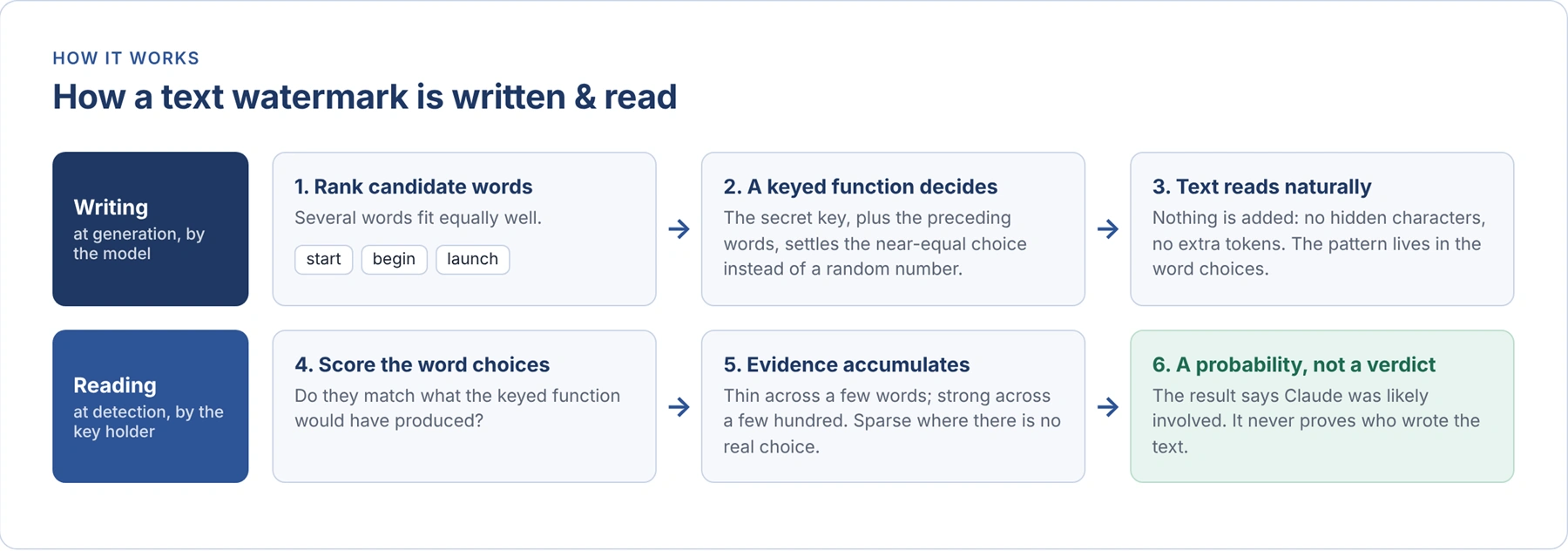
The technique has a clear lineage. Researcher Scott Aaronson proposed statistical watermarking for language models in 2022, & Google DeepMind published SynthID-Text in Nature in 2024. Claude's watermark is a version of that approach. Anthropic points to Google's own testing, in which a watermarked model served to part of Gemini's traffic showed no statistically significant difference in user ratings. The engineering implication is worth stating plainly. The mark is not added to the text after it is written. It is a property of how the text was generated, which is why it travels with copied text & survives light editing, & why a complete rewrite removes it.
AI Watermarking Approaches: Text, Media, C2PA and AI Detection
Watermarking is one of four ways to establish where content came from, & each answers a different part of the problem.
| Approach | How it works | Where it is strong | Where it is limited |
|---|---|---|---|
| Statistical text watermark | A keyed function steers low-stakes word choices as the text is generated. | Travels with copied text. Nothing visible is added. No extra cost to the user. | Needs longer passages. Sparse in factual text, code & proofreading. A full rewrite removes it. Only the key holder can read it. |
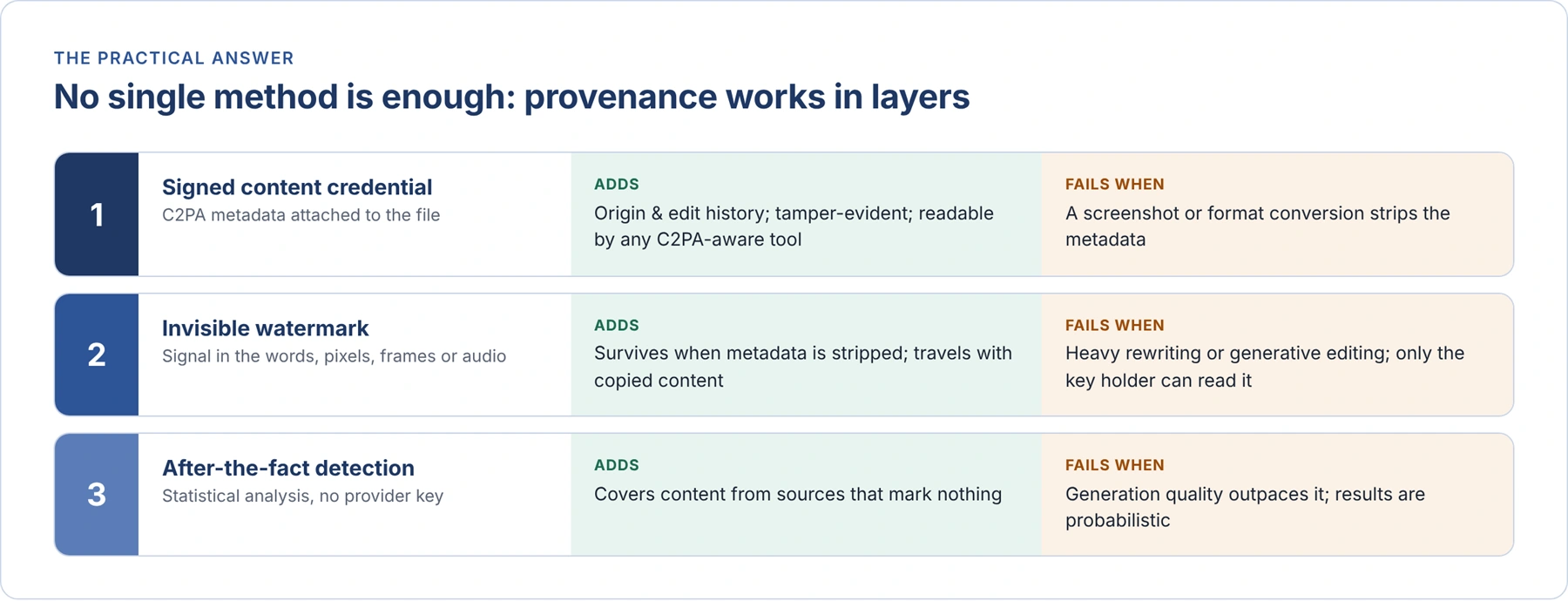
| Media watermark (pixels, frames, audio) | An imperceptible signal is embedded in the pixels, frames or audio of the content itself. | Reported to survive filters & colour changes. Remains when metadata is lost. | Detectable only by a matching detector. Covers only generators that take part. |
| Content credentials (C2PA) | A cryptographically signed record of origin & edits is attached to the file. | Tamper-evident. Open standard read by compatible tools. | Metadata can be stripped by a screenshot or a format conversion. Shows involvement, not full authorship. |
| After-the-fact AI detectors | Software judges style & phrasing for statistical tells, without any provider key. | Can be applied to content from any source. | Probabilistic. Has to keep pace with improving generation quality. |
Table 1: Four ways to establish where content came from.
No single method is sufficient, & the EU framework says so directly. The Code of Practice does not prescribe one technique, because no single technique currently meets all four requirements in Article 50: marks must be effective, interoperable, robust & reliable. The practical answer is layering. A signed credential carries origin information, a watermark survives when the metadata is stripped, & after-the-fact detection covers content from sources that mark nothing.
There are four reasons to think this approach has a better chance than earlier attempts.
- The first is legal force. Article 50 is binding, the Code has about 190 signatories & the obligation reaches any provider serving European users, which in practice includes most of the major ones.
- The second is cost. The provider carries it; the user pays nothing & the providers report no practical effect on output quality.
- The third is shared building blocks. Anthropic's text watermark derives from Google's published method, OpenAI uses SynthID for images & C2PA is used by camera manufacturers & photo-editing software.
- The fourth is that the claim is modest. A watermark asserts a probability of involvement, not authorship, & a modest claim is easier to defend.
Success also depends on conditions that are not yet met. Verification is the weak point. One recent analysis notes that Article 50 does not require marks to be evaluated under a shared protocol, audited independently of the provider or checked through detection interfaces the providers do not control. Today a Claude watermark can be read only by someone with access to Anthropic's key, & that access is limited to eligible organisations. Open-weight models & providers outside the Code will not necessarily mark their output at all, so the absence of a watermark is not evidence of human authorship. A watermark is evidence, not a verdict, & the systems built on top of it have to treat it that way.
The EU Code of Practice explicitly mandates that by 2 February 2027, all participating providers must make their watermark detection mechanisms fully interoperable (via industry-standard query-routing or shared provider-agnostic verification interfaces), removing the current single-vendor verification bottleneck.
The Challenges & Limitations of AI Watermarking
Text watermarking is the newest layer & the hardest to get right. A paragraph offers far fewer interchangeable choices than a photograph offers pixels, so there is less room to hide a signal. Paraphrasing weakens the mark, & short passages may not contain enough evidence to detect. The early signs reflect that. Anthropic's detection API is in private preview, its coverage is still extending to earlier models, & the first public reaction included criticism from users who worry about being wrongly accused of using AI for work they wrote themselves.
The broader picture is moving quickly. Regulation is spreading beyond Europe: China has required both explicit & implicit labelling of AI-generated content since September 2025. Provider cooperation is deepening, & OpenAI's decision to use Google's SynthID for images is an example of competitors sharing infrastructure for a common problem. What is being built is not a single product but a trust layer for content. The work of making it interoperable, independently verifiable & widely accessible has barely begun.
Comparative Empirical Benchmarks (Yu & Wei, 2026, arXiv:2601.16140) reveal a fundamental discovery: Spatial and Latent watermarking paradigms exhibit mathematically ORTHOGONAL vulnerabilities. Spatial watermarks (e.g. RivaGAN, pixel-level) suffer 67.47% Adversarial Evasion Rate (AER) under generative Img2Img translation and 66.80% AER under Inpainting, as diffusion noise filters overwrite localized high-frequency pixels. Conversely, Latent watermarks (e.g. Tree-Ring, Fourier frequency-level) easily survive generative editing (17.73% AER) but suffer 43.20% AER evasion under static cropping due to Fast Fourier Transform (FFT) grid desynchronization. This proves that single-domain watermarking is fundamentally incomplete and establishes the urgent exigence for multi-domain, dual-layer cryptographic architectures.
AI Watermarking for Images, Video & Audio
Text is the newest modality to be marked, not the first. Images, video & audio carry more persuasive weight than a paragraph, & they are where the most serious misuse has occurred, so the marking technology there is further along.
Google DeepMind's SynthID embeds the watermark in the pixels of the image itself. Two neural networks are trained together, one to embed an imperceptible signal & the other to detect it. Google reports that the signal remains detectable after filters, colour changes & brightness adjustments, & after the metadata has been lost.
For video, the same approach is applied to every frame of the generated clip, & audio carries an inaudible signal in its time-frequency structure.
Content credentials work differently. Under the C2PA standard, a small cryptographically signed record of origin & edits is attached to the file's metadata. Nothing in the pixels changes. Any C2PA-aware tool can read the record, & tampering with it is detectable, but a screenshot or a format conversion can strip the metadata altogether. That is why the two techniques are used together. OpenAI, for example, now attaches C2PA credentials & SynthID watermarks to images generated through ChatGPT, Codex & its API, & runs a public preview tool at openai.com/verify that checks for both. Claude's image files carry C2PA credentials.
The range of content that needs marking is wider than most organisations assume.
- A synthetic voice can pass a call-centre authentication step.
- An AI-generated photograph can be submitted as evidence of vehicle damage.
- A short video of an executive can be produced from public footage.
- A fabricated invoice or identity document can be rendered convincingly in seconds.
Each of these is a category in which the receiving organisation needs a way to ask whether the content was machine-generated, & each is one where marking at the source gives it something to check.
Enterprise Use Cases for AI Watermarking & Content Provenance
Fraud & Executive Impersonation
In early 2024, a finance employee at the engineering firm Arup in Hong Kong joined a video call with people who appeared to be the company's chief financial officer & colleagues. According to Hong Kong police, everyone on the call except the employee was a deepfake. The employee made 15 transfers totalling HK$200 million, about $25.6 million, & Arup confirmed that fake voices & images were used.
Watermarking would not have stopped that attack on its own, because an attacker is unlikely to use a generator that marks its output. What marking enables is the other side of the problem: a way to establish that legitimate content from cooperating systems is what it claims to be, & a signal that platforms & verification tools can act on. Marking works best alongside process controls, such as out-of-band verification of payment requests.
Insurance Claims & Evidence
Claims handlers increasingly treat manipulated photographs & altered documents as a distinct category of fraud. A damaged photograph generated or edited by an AI system can look indistinguishable from a genuine one. Where the generator marks its output, or where the capture device attaches a signed credential now of capture, the insurer has something concrete to verify. The benefit is not that every fake is caught. It is that genuine evidence can be positively authenticated, which shifts the burden of proof in a way that suits honest customers.
Journalism, Factchecking & Elections
Anthropic lists media organisations & factcheckers among the eligible users of its detection API, & OpenAI has described provenance as a tool for detecting coordinated disinformation & supporting election integrity. For a newsroom, the value of a mark is speed: a quick signal on whether an image or a passage came from a participating generator, before more expensive verification begins. The limit is equally important. A missing mark proves nothing, so provenance tools support editorial judgement. They do not replace it.
Education & Hiring
Educational organisations are among the eligible users of Claude's detection API, which makes this the use case with the sharpest risks. A watermark that is present shows that Claude was likely involved at some point. It does not show who wrote the text, how much of it, or whether the student or candidate simply asked for a grammar check. Because the mark is sparse in lightly edited text, its absence is equally uninformative. Institutions that treat a watermark as proof will wrongly accuse honest people. The responsible use is as one input among several, with a human decision & a right of reply.
Regulated Enterprise Content
For enterprises, marking is becoming a compliance matter. Anthropic notes that enterprises with their own obligations to verify watermarking under the EU AI Act can use its detection API, & the Act also places disclosure duties on organisations that deploy AI to generate deepfake-style content. Customer communications, medical or legal summaries, marketing imagery & internal reports are all categories in which an organisation may need to show, after the fact, which content was machine generated. That is a records question as much as a technology question, & it points to a practical step: know which AI systems produce content inside your organisation, & what each one marks.
Enterprise AI Content Governance frameworks (Trussed AI & EU AI Act Deployer Guide) require stacking complementary runtime controls:
- Mandatory C2PA credential & watermark issuance at generation/export gateways
- Preservation of manifests across CMS/DAM editing tools without silent stripping
- Verification at ingest and pre-publish gateways
- Policy-based execution (Allow, Label, Block, Escalate) with logging, SIEM integration, and Fundamental Rights Impact Assessments (FRIA)
How UnfoldLabs Can Add Value
For enterprises, AI provenance is unlikely to be solved by purchasing one detector or switching on one watermark. The harder work happens between systems.
Content may be created in one AI platform, stored in another, edited in a CMS or DAM, attached to CRM records, published through a portal, processed by automation, and later used in a regulated or customer-facing workflow. The organisation has to decide where provenance is preserved, where it is checked, what policy applies, and how exceptions are handled.
That is fundamentally an architecture and integration challenge. UnfoldLabs works across technology solution development, architecture, custom development, integration, implementation, cloud, mobile, and CX environments. That makes UnfoldLabs well placed to help enterprises fit emerging provenance and verification capabilities into their existing technology ecosystems.
A practical engagement could begin by mapping:
- Where AI-generated content enters the organisation.
- Which models and external services generate that content.
- Which systems modify, store, or publish it.
- Where provenance information may be lost.
- Which business journeys require verification.
- Which decisions require human intervention.
- What should be recorded for governance and audit.
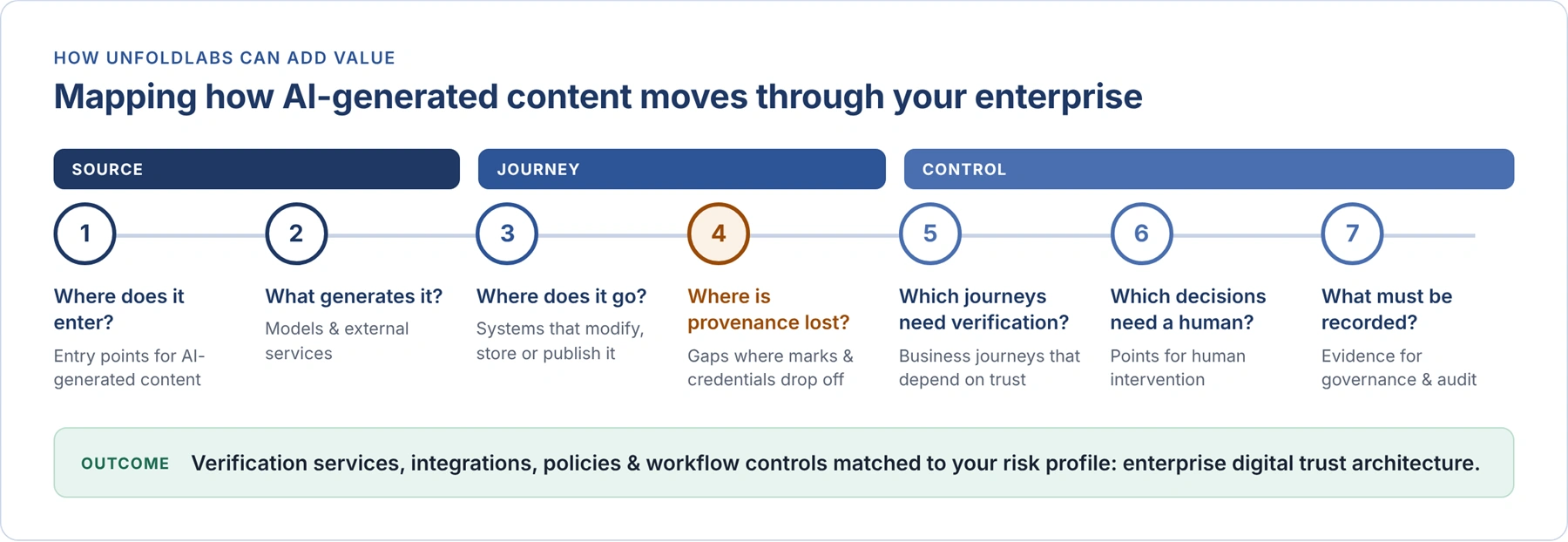
From there, enterprises can determine which verification services, integrations, policies, and workflow controls are appropriate to their risk profile. This moves the conversation beyond AI watermarking. It becomes enterprise digital trust architecture.
My Thoughts
The most useful way to read the watermarking story is as a change in method. For three years the industry has tried to detect AI content after this fact, by inspecting it for tells. That approach has a ceiling, because detection must keep pace with generation, & generation is improving quickly. Marking at the source changes the question from whether content looks artificial to whether it can show where it came from. The first question gets harder every year. The second can be answered by engineering.
I would offer three observations for technology leaders.
- First, treat a watermark as evidence, not proof, & build processes in which a positive result opens a question & a negative result closes nothing.
- Second, expect provenance to become a standard property of content pipelines, in the way encryption became a standard property of data transport. That means asking each AI vendor what it marks, how it marks it & who can verify the mark, & record the answers.
- Third, remember that marking cooperates with honest actors. It makes legitimate content easier to authenticate. It does not stop a determined attacker, who will use tools that mark nothing, so the controls around payments, identity & evidence still have to hold.
The longer-term outcome I expect is layered: credentials attached at creation or capture, watermarks that survive when metadata is stripped, detection access that widens beyond regulators & large platforms, & shared standards that let one vendor's mark be read by another's tools. None of that is finished. All of it is now under way, & the organisations that start asking provenance questions today will be better placed than those that wait for an incident to prompt them.
Trust, in the end, will not be something we discover by looking harder. It will be something we build into the way content is made. Watermarks provide supportive probabilistic evidence, but cryptographically signed C2PA credentials, multi-domain dual-layer watermarking (spatial + latent), and runtime policy gateways form the irreplaceable bedrock of enterprise digital trust.
If your organisation creates, receives or publishes content that people need to trust, now is the right time to find out what your systems mark & what they miss. For more info & support, contact us!
"The future of trust will not depend on spotting what looks artificial. It will depend on being able to show where content came from."
– Asokan Ashok, CEO, UnfoldLabs Inc.

Can Your Enterprise Trace the Content It Trusts?
If AI-generated content is already entering customer interactions, operational workflows, documentation, marketing, software, or regulated processes, provenance should be part of the architecture conversation.
Talk to UnfoldLabs about evaluating how AI-generated content moves through your enterprise and where provenance, verification, integration, and policy controls can strengthen digital trust.